Field metering and protection
APM meters collect electrical and energy readings. MPR relays provide protection, breaker status and event data.
From field metering, protection and communications to single-line displays, alarms and energy reports.
APM meters collect electrical and energy readings. MPR relays provide protection, breaker status and event data.
A gateway collects configured points from field devices and forwards them over Ethernet.
The platform displays circuit status on single-line views and provides configured alarms, trends, event records and energy reports.
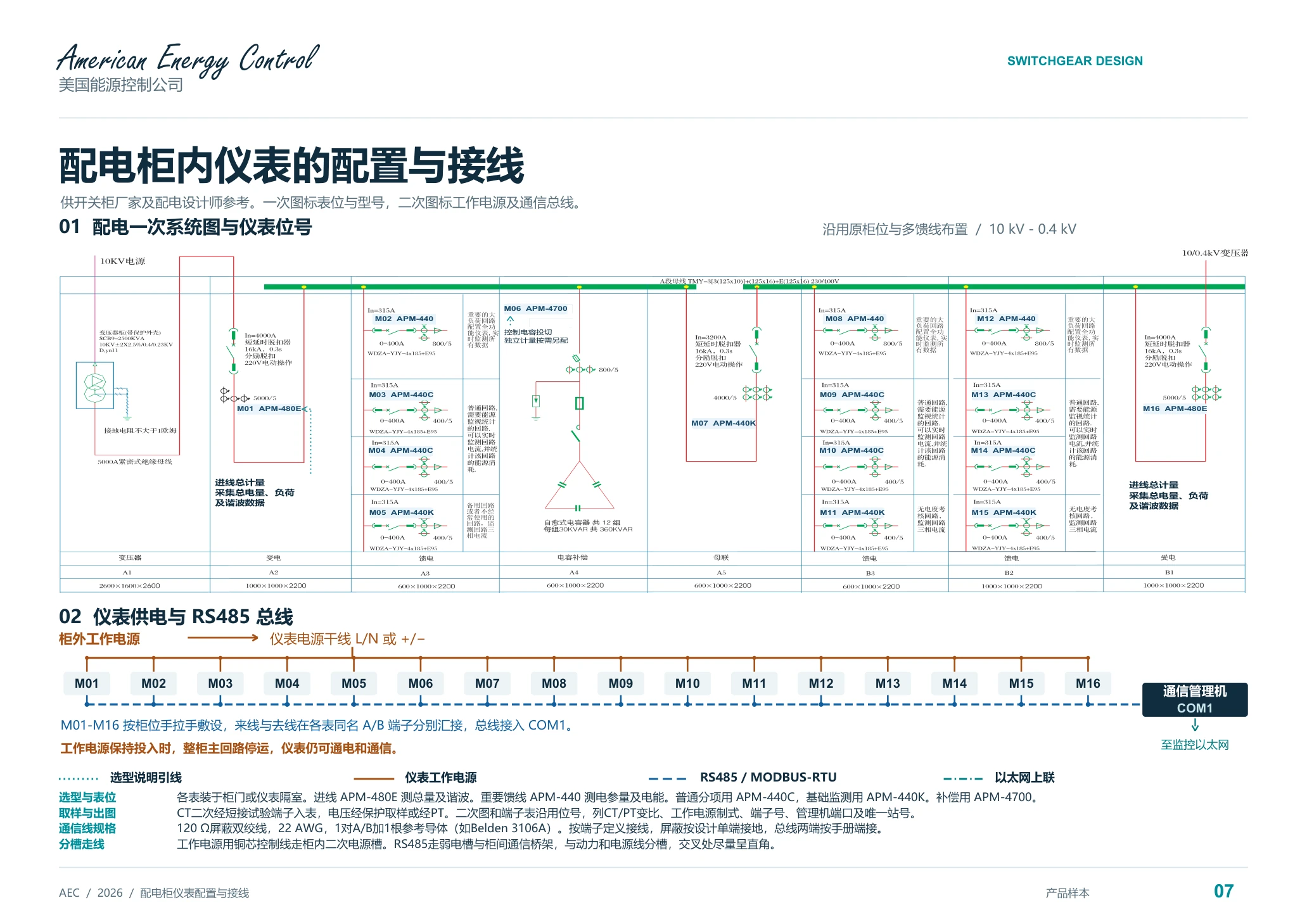
List incomers, feeders, bus ties, capacitor panels and critical loads. Separate metering, protection and control by circuit. Record the model, measurement inputs and interface on drawings, and define status and alarm points.
Verify CT/PT ratings, ratios and breaker auxiliary contacts against the device inputs. Check cutouts, auxiliary supply, terminal locations and I/O circuits during panel engineering.
Plan RS485 segments and device addresses. Poll Modbus RTU through a gateway, verify registers, scaling and units, and forward the data over Ethernet. Confirm other relay protocols against project interfaces.
Map points to circuits and configure the single-line display, alarms, event records, trends and energy reports. Verify status, readings, communication loss and event time, and distribute data to authorized systems.
Separate metering, protection and control, then use the table to shortlist devices. Check the corresponding MPR models for bus ties, transformer differential and dedicated motor protection.
| Cubicle or circuit | Candidate product | Selection criteria |
|---|---|---|
| LV incomers and key metering circuits | APM-480 | Choose APM-480 for time-of-use metering or an LCD. Compare APM-480E when harmonic analysis is required. |
| Standard LV feeders | APM-440 | Match the variant to full electrical measurements, current only, or current plus energy metering. |
| Feeder protection panels | MPR-2013 | Combine feeder protection, breaker status, control and recording, then match the communications interface to the network. |
| Feeder, transformer or motor circuits requiring overcurrent protection | MPR-2014 | Verify phase and earth-fault overcurrent, non-electrical protection and reclosing requirements against the protection design. |
| LV capacitor compensation panels | APM-4700 | Match the compensation mode, incoming current sampling and number of stages, up to 12 groups. |
Collect energy and load trends by key circuit to support submetering and load analysis.
Use breaker status, relay operations, event sequence and disturbance records to locate a circuit and reconstruct an incident.
Inventory compatible installed devices, start with key measurements and alarms, then add reporting and remote operations as interfaces permit.
Connect circuit-level energy readings to workshops, floors or equipment to see where energy goes, when demand peaks and how results change after an upgrade.
Map meters to incomers, workshops, production lines or floors. Collect readings automatically and aggregate energy use by shift, day or month.
Review load peaks and valleys alongside production shifts or opening hours. Investigate loads that persist outside operating hours and differences between circuits.
Record energy use, output or operating hours before a change. Compare the same metering points and reporting periods afterward, accounting for changes in output or operating hours.
Meter HVAC, common areas and tenants separately. Compare overnight demand with opening hours and monitor incomer and transformer loading.
Track shift energy use by workshop or production line and compare it with output. If a breaker trips, use alarms and event sequences to identify the affected circuit.
Share the single-line diagram, cubicle schedule, CT/PT inputs, auxiliary supply and communications requirements for configuration review.